
Google Ads
Google Ads management that captures demand at the moment it matters
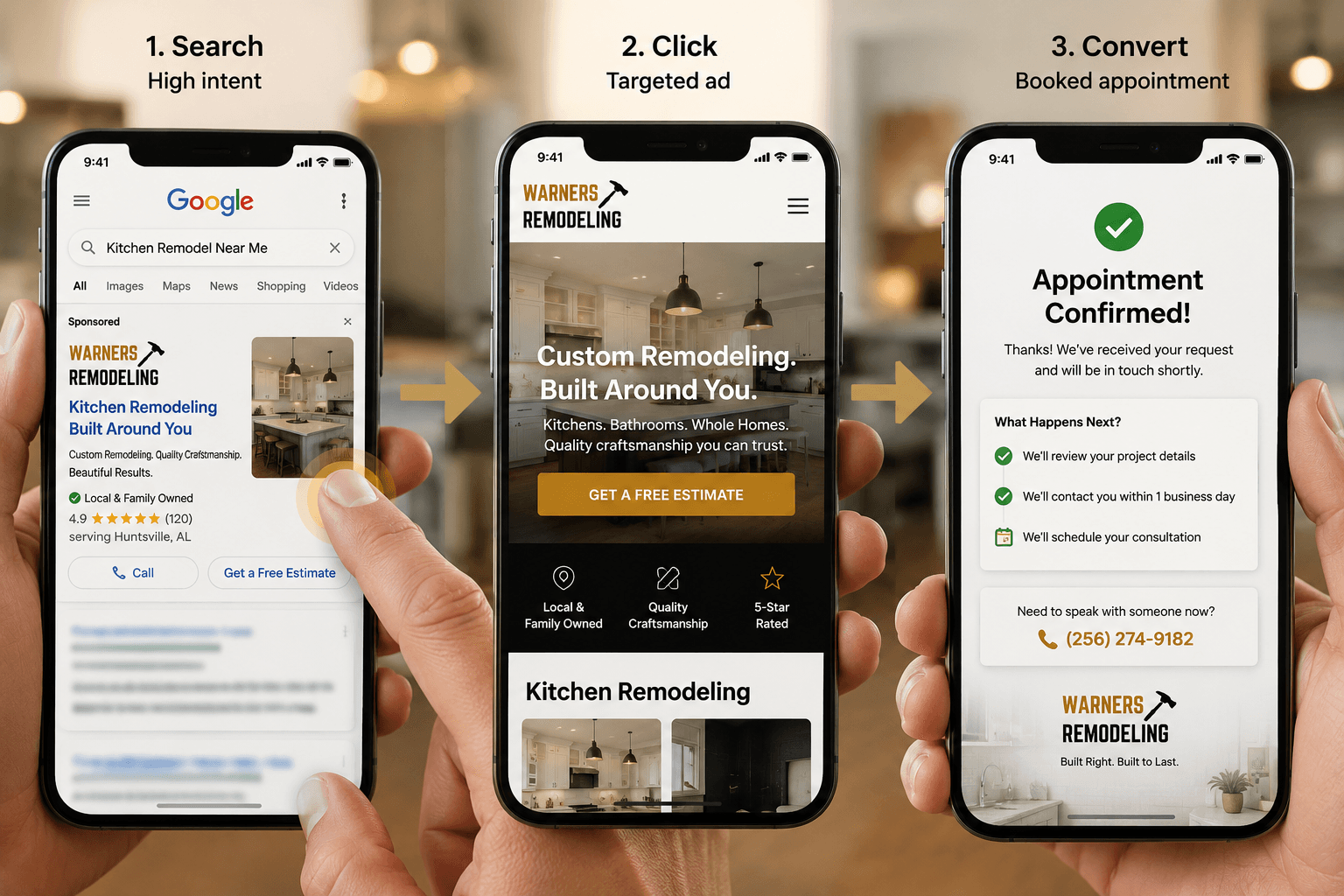
Google Ads is the fastest way to put your business in front of someone who needs your service today. It is also the fastest way to waste money. The difference is entirely in the targeting, the landing page, and whether you are tracking real leads or raw clicks.
- Tightly structured campaigns, not broad-match guesswork
- Negative keyword discipline that cuts wasted spend
- Conversion tracking tied to actual leads and revenue
Free consultation
Let's talk about where your business is going
Share a few details and we'll follow up to talk through your google ads goals and where you want to be in the next three to six months.
- A real person replies during business hours
- No long-term contract required to start a conversation
- Straight answers about what will and won't move the needle
Prefer to call? (256) 474-3628 · Monday–Friday, 8:00 AM–5:00 PM
The problem
Where ad budgets usually leak
When we audit an underperforming account, the same handful of problems come up almost every time.
You are paying for the wrong searches
Broad match without disciplined negative keywords means paying for job seekers, students, DIY researchers, and people in cities you do not serve. It is the single largest source of wasted spend we find.
Clicks land on your homepage
Someone searching for one specific service arrives at a general homepage and has to hunt for what they wanted. Message match is one of the biggest levers on conversion rate, and it is usually ignored.
Conversions are counted, not qualified
If every form fill and page view counts as a conversion, the platform optimizes toward volume rather than customers. Google will faithfully deliver more of whatever you tell it to value.
Automated campaign types run unsupervised
Performance Max and broad automated campaigns can work, but pointed at a small local budget without constraints they often spend on cheap, low-intent placements.
Leads arrive and nobody follows up fast
You can run a technically excellent campaign and still lose the customer because the lead sat in an inbox for six hours. Ad performance is capped by what happens after the click.
Nobody is watching the account
Search terms shift, competitors change bids, and costs drift upward. An account set up once and left alone quietly gets more expensive every month.
None of this requires a bigger budget to fix. It requires structure, discipline, and honest measurement.
What it is
How we manage Google Ads
Our approach is built around a simple principle: spend money only on searches that can realistically become customers, and send those clicks to a page built to convert them. Most of the work is subtraction rather than addition.
We build campaigns segmented by service and intent, so budget, messaging, and landing pages can be matched to what the person actually searched. We use tighter match types, aggressive negative keyword lists, and geographic targeting drawn to your real service area rather than a lazy radius.
Conversion tracking is set up to measure qualified leads, not clicks or generic events. Where possible we connect ad spend through to CRM outcomes, so we can see which campaigns produced booked work rather than which produced form fills. That is what lets us shift budget toward what actually pays.
Then it is ongoing management: reviewing search terms, pruning waste, testing ad copy and landing pages, adjusting bids and budgets by performance, and watching for the account drift that erodes results if nobody is paying attention.
This is a strong fit if
- You need lead flow now rather than in six months
- Customers actively search for what you sell, with clear intent
- Your average customer value supports a meaningful cost per lead
- You are already spending on ads and are not sure it is working
- You have capacity to handle more work and want to fill it predictably
- You want to test a new service or service area before committing to it
Probably not the right fit if
- Your budget is too small to gather meaningful data in your market
- Nobody can respond to inbound leads within the hour
- You have no website or landing page capable of converting paid traffic
Outcomes
What better ad management changes
We optimize toward the numbers that affect profit, not the ones that make a report look busy.
Wasted spend
Less budget on unqualified clicks
Negative keyword discipline and tighter targeting redirect spend away from searches that were never going to convert and toward the ones that do.
Cost per lead
More leads from the same budget
Improving message match and landing page conversion means a higher share of the clicks you already pay for turn into inquiries.
Lead quality
Inquiries you actually want
Filtering by intent, geography, and service means fewer calls about work you do not do or areas you do not serve.
Attribution
Clarity on what produces revenue
Connecting ads through to CRM outcomes shows which campaigns generate booked work, so budget decisions stop being guesses.
Speed
Demand you can turn on deliberately
When you have capacity to fill or a slow season to cover, paid search produces qualified traffic within days rather than months.
Control
Spend that scales with what works
Once cost per acquired customer is known and stable, increasing budget becomes a business decision rather than a gamble.
The process
How we run a paid search engagement
Whether we are auditing an existing account or building from scratch, the sequence is the same.
- 01
Audit and economics
We review your account history, conversion tracking, and search term data, then establish what a customer is worth so we can work out a viable cost per lead.
- 02
Fix the measurement first
Before changing bids, we make sure conversion tracking is accurate and counting qualified leads. Optimizing against bad data just gets you to the wrong place faster.
- 03
Structure and targeting
We build campaigns segmented by service and intent, define geographic targeting around your real service area, and establish negative keyword lists from day one.
- 04
Ads and landing pages
We write ad copy matched to each search group and pair it with a landing page built for that single action, rather than sending everything to the homepage.
- 05
Launch and monitor closely
Early weeks get frequent attention: reviewing actual search terms, cutting waste, and adjusting before budget is spent learning the same lesson twice.
- 06
Optimize and report
Ongoing testing of copy, pages, bids, and budget allocation, with monthly reporting on spend, leads, cost per lead, and where the budget went.
Capabilities
What management covers
Adjusted to your budget, market, and how competitive your service is.
Search campaign build and structure
Campaigns and ad groups segmented by service, intent, and margin.
Negative keyword management
Ongoing search term review to cut spend on searches that cannot convert.
Geographic targeting
Targeting drawn to your actual service area, with bid adjustments by location value.
Landing page development
Conversion-focused pages matched to each campaign's search intent and offer.
Conversion tracking setup
Accurate tracking of calls, forms, and bookings, with call tracking where it applies.
CRM and offline conversion linking
Connecting ad spend to closed revenue so optimization targets customers, not form fills.
Remarketing
Re-engaging visitors who showed intent but did not convert on their first visit.
Budget pacing and reporting
Spend management with plain reporting on cost per lead and cost per customer.
How we work
How we handle your ad budget
You are trusting us with money that leaves your account every day. These are our commitments about that.
Your account stays in your name
We work inside an account you own, with your billing and full administrative access. If we part ways, you keep the account, its history, and all the learning in it.
Transparent spend and fees
You always see exactly what went to Google and what our management fee is. No blended invoices that obscure how much of your budget reached the auction.
We will tell you if ads are wrong for you
If your customer value cannot support the cost per click in your market, we will say so rather than take a management fee to spend your money badly.
Measurement before optimization
We fix tracking before touching bids. Reporting on leads we cannot verify is how agencies produce impressive reports alongside disappointing bank statements.
FAQs
Frequently asked questions
NOT SURE THIS IS YOUR BIGGEST PROBLEM?
Find the biggest leaks across your entire marketing system.
Three minutes, 21 questions, and a prioritized diagnosis. If the answer is not this service, we will tell you that.
Related services
What makes paid search work harder
Ads perform best when the page converts, the follow-up is fast, and you are also building visibility you do not rent.
Websites & Landing Pages
The single biggest lever on ad performance. Purpose-built landing pages convert paid traffic far better than a homepage.
Learn moreCRM & Marketing Automation
Ensures the leads your ads produce get an immediate response and structured follow-up rather than sitting in an inbox.
Learn moreSEO & Local Search
Builds durable visibility alongside paid, reducing long-term dependence on buying every click.
Learn more
Find out where your ad budget is going
We will audit your account structure, search terms, conversion tracking, and landing pages, then show you the specific waste and the realistic opportunity. If paid search is not right for your economics, we will tell you that too.