
Analytics & Growth Strategy
Marketing analytics and growth strategy that show what is working
Most small businesses have plenty of marketing data and almost no clarity. Traffic in one dashboard, leads in another, jobs in a third, and no reliable way to connect spend to revenue. That gap is where budget quietly gets wasted.
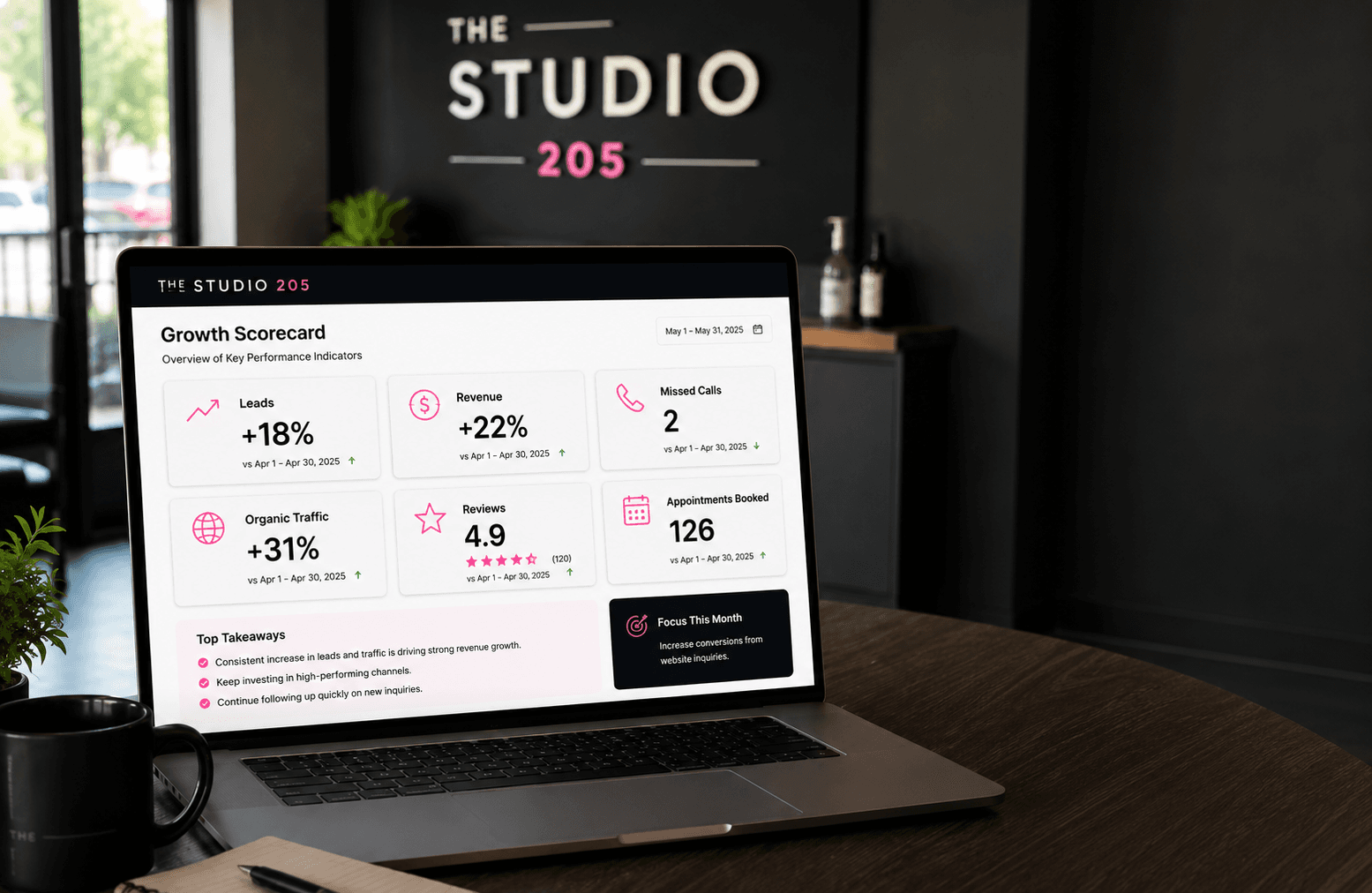
- One scorecard connecting spend to booked revenue
- Funnel measurement that locates the actual bottleneck
- Plain reporting, not dashboards nobody reads
Free consultation
Let's talk about where your business is going
Share a few details and we'll follow up to talk through your analytics & growth strategy goals and where you want to be in the next three to six months.
- A real person replies during business hours
- No long-term contract required to start a conversation
- Straight answers about what will and won't move the needle
Prefer to call? (256) 474-3628 · Monday–Friday, 8:00 AM–5:00 PM
The problem
Why your marketing data is not helping
Having numbers is not the same as being able to make decisions with them. These are the gaps we find most often.
Systems do not talk to each other
Website analytics, ad platforms, your CRM, and your invoicing all hold pieces of the picture. Nothing joins them, so nobody can trace a customer back to what produced them.
Nobody knows where customers come from
Ask which channel produced last month's best jobs and the answer is usually a guess. Budget decisions then get made on impressions rather than evidence.
Phone calls are invisible
For most local businesses the phone is the primary conversion, yet calls are the least tracked. Without call tracking, the most important channel is measured worst.
Conversion tracking is broken or inflated
Tracking that counts page views, partial forms, or duplicates makes weak channels look strong. Optimizing against it actively moves budget the wrong way.
Reports measure activity, not results
Impressions, reach, clicks, and rankings describe effort. They say nothing about whether the business grew, and they are the metrics most agencies lead with.
You cannot find the bottleneck
Without funnel-level measurement, it is impossible to tell whether the problem is traffic, conversion, lead quality, or follow-up — so effort gets spent in the wrong place.
The goal is not more dashboards. It is a small set of numbers you trust enough to make decisions with.
What it is
How we approach measurement
We start from the business questions worth answering: what does a customer cost by channel, which sources produce work you actually want, where in the funnel people drop off, and what a customer is worth over time. Then we build only the measurement needed to answer those, rather than instrumenting everything and drowning you in charts.
Practically, that means getting conversion tracking correct and honest first — counting qualified leads rather than clicks or loose events — then connecting channels through to CRM and revenue so we can report cost per acquired customer instead of cost per click. Call tracking usually matters more than anything else for local businesses, because the phone is where most real conversions happen.
With the foundation in place, we measure the funnel as a sequence: visibility, traffic, conversion to inquiry, inquiry to appointment, appointment to sale, and repeat purchase. Locating which stage is actually constraining growth is what turns marketing from a series of experiments into a strategy.
Reporting is deliberately plain. A short monthly review covering what happened, what it cost, what it produced, what we learned, and what we are changing. If a report needs interpretation to be useful, it is not a useful report.
This is a strong fit if
- You are spending on marketing without knowing what it returns
- You run several channels and cannot compare them fairly
- Most inquiries arrive by phone and go untracked
- You suspect budget is being wasted but cannot prove where
- You want to scale spend and need confidence before increasing it
- Agency reports look positive while revenue stays flat
Probably not the right fit if
- You have essentially no marketing activity yet to measure
- You are unwilling to change budget allocation based on findings
- Volumes are so low that data cannot yet be meaningful
Outcomes
What clear measurement changes
Better data rarely produces a dramatic moment. It produces steadily better decisions.
Attribution
You know what produces customers
Connecting spend to closed revenue shows which channels earn their budget and which have been coasting on soft metrics.
Waste
Unproductive spend gets cut
Once cost per acquired customer is visible by channel, the underperformers become obvious and the budget can move.
Bottlenecks
Effort goes where it matters
Funnel measurement distinguishes a traffic problem from a conversion or follow-up problem, which prevents solving the wrong one.
Confidence
Scaling becomes a decision, not a gamble
Knowing what a customer costs and is worth turns increasing budget into arithmetic rather than hope.
Lifetime value
Repeat revenue becomes visible
Measuring beyond the first sale often reveals that channels judged expensive are actually the most profitable.
Accountability
Marketing can be judged fairly
Shared, trusted numbers mean performance conversations rest on evidence rather than competing interpretations.
The process
How we build your measurement system
Foundations first. Reporting built on inaccurate tracking is worse than no reporting.
- 01
Define the questions
We agree on the specific decisions you need to make, then work backwards to the minimum measurement required to inform them.
- 02
Audit existing tracking
We review analytics, ad conversion tracking, and CRM data for inflation, duplication, and gaps. This step usually explains a lot.
- 03
Fix the foundation
We correct conversion definitions so they count qualified leads, and implement call tracking so phone conversions are finally visible.
- 04
Connect the systems
We link channels through to CRM and revenue data so cost per customer can be reported rather than estimated.
- 05
Build the scorecard
We create one clear view of the numbers that matter, at the funnel stages that matter, and nothing more.
- 06
Review and act monthly
We meet to interpret the numbers, decide what to change, and act — because reporting that does not change behavior is overhead.
Capabilities
What this includes
Scoped to your channels, systems, and the decisions you need to make.
Conversion tracking audit and repair
Accurate, honest conversion definitions across every channel.
Call tracking
Attributing phone conversions to the channel and campaign that produced them.
CRM and revenue integration
Connecting marketing activity through to booked jobs and closed revenue.
Funnel measurement
Stage-by-stage conversion rates that locate the real constraint.
Unit economics
Cost per lead, cost per customer, and lifetime value by channel.
Scorecard and reporting
One plain view of what happened, what it cost, and what it produced.
Analytics and consent configuration
Clean, privacy-conscious implementation you can rely on.
Growth strategy sessions
Regular reviews that turn findings into specific budget and priority decisions.
How we work
How we handle measurement
Analytics is where an agency can most easily flatter itself. These are our safeguards against that.
We report numbers that can make us look bad
If a channel we recommended is not producing, that appears in the report. Measurement is only useful if it is allowed to deliver unwelcome answers.
You own all accounts and data
Analytics properties, tracking configurations, and call tracking accounts are yours, with full access and exportable history.
No vanity metrics as headlines
Impressions and reach may appear as context, never as the result. The headline is always leads, customers, and revenue.
We fix tracking before optimizing
We will not tune campaigns against data we know is wrong, even when that delays visible activity by a few weeks.
FAQs
Frequently asked questions
NOT SURE THIS IS YOUR BIGGEST PROBLEM?
Find the biggest leaks across your entire marketing system.
Three minutes, 21 questions, and a prioritized diagnosis. If the answer is not this service, we will tell you that.
Related services
What measurement improves
Analytics is the layer that makes every other channel accountable.
Google Ads
The channel where accurate conversion data has the most immediate financial impact, since spend moves daily.
Learn moreCRM & Marketing Automation
The system holding the outcome data that makes revenue attribution possible in the first place.
Learn moreWebsites & Landing Pages
Where funnel measurement most often points, since conversion rate is usually the cheapest thing to improve.
Learn more
Find out what your marketing actually returns
We will audit your tracking, identify where attribution is broken, and show you the specific numbers you are missing to make confident budget decisions.